Height, Weight, and the Evolution of Baseball Players
Have MLB Players Been Getting Bigger?
When examining a single season in isolation (such as 2024), Major League Baseball rosters feature approximately 1,500 active players distributed across a spectrum of heights and weights. While that snapshot shows how different defensive positions demand distinct physical attributes, it leaves an essential historical question unanswered: have baseball players actually been getting bigger over time?
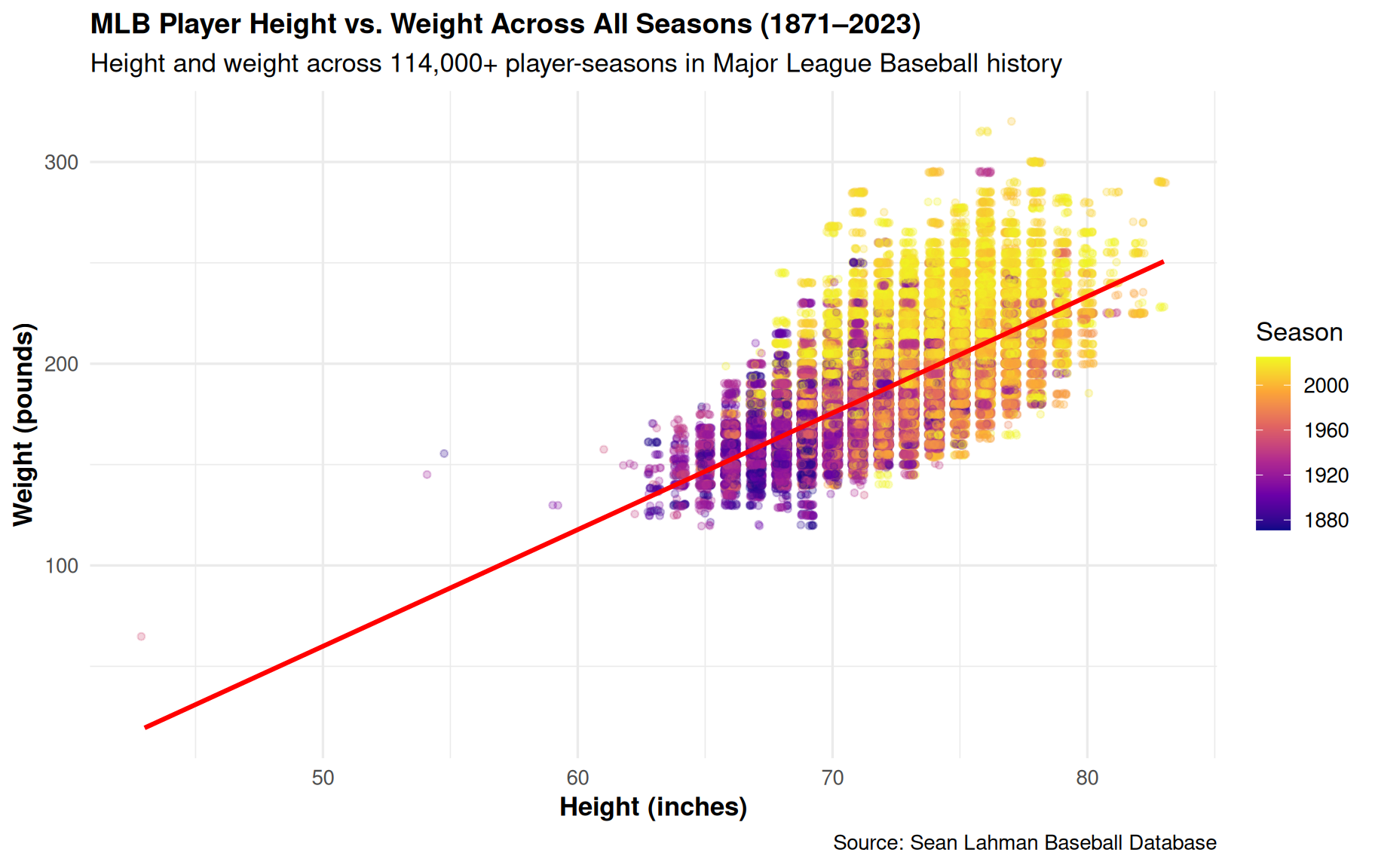
By expanding our scope across all Major League Baseball seasons in recorded history (1871–2023), our dataset expands comfortably into the thousands—encompassing over 114,000 player-season observations. This all-time perspective allows us to observe not only how height and weight relate to one another within the sport, but also how the entire distribution of professional ballplayers has steadily shifted upward across generations.
The scatterplot reveals a striking upward migration across history. In baseball’s earliest eras, the average major leaguer was substantially lighter and shorter, typically standing under 5’10” and weighing under 170 pounds. Over the decades, as shown by the gradient from dark purple (early seasons) to vibrant yellow (modern seasons), player body types steadily shifted upward and outward.
Today’s modern major league players extend into the upper-right quadrant, regularly exceeding 6’3” and 220 pounds. By examining data across all seasons rather than a single year, we can conclusively observe that professional baseball players have grown measurably taller and substantially heavier over the sport’s history.