The Story: Shapes of the Game
Physical Archetypes in Modern Baseball
Baseball is fundamentally a game of specialized defensive and offensive roles. Unlike sports where athletes converge toward a single uniform body type, baseball demands vastly different physical profiles depending on what each position requires on the field. A player who excels at tracking down grounders in the hole between short and third brings a completely different set of physical mechanics to the game than a pitcher generating downward plane from the mound.
When we inspect height and weight distributions across positions, distinct physical archetypes immediately stand out.
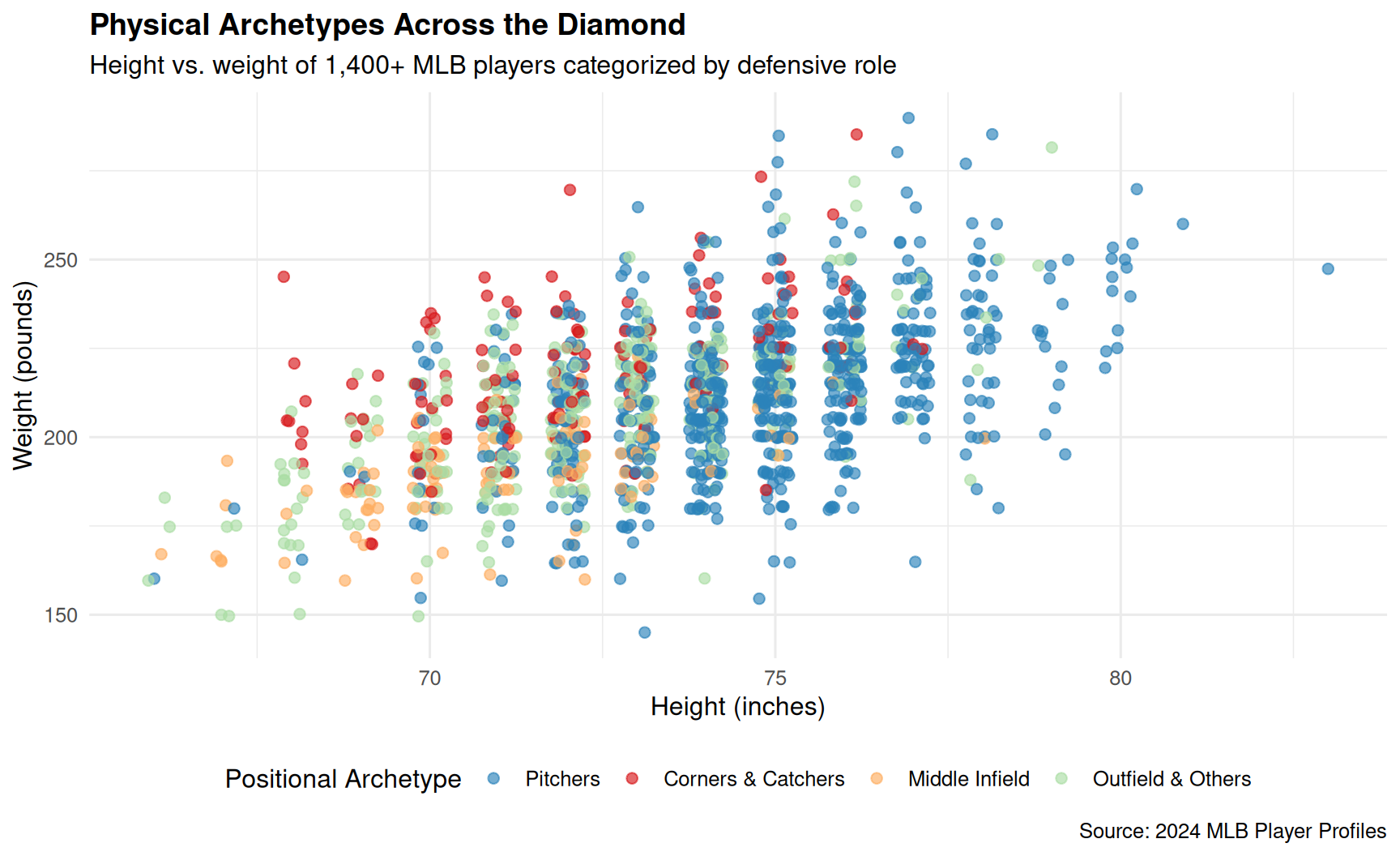
As the scatter plot above illustrates, modern rosters divide neatly into specialized physical clusters:
- Pitchers dominate the upper reaches of height, frequently standing 6’3” to 6’6” or taller. Longer limbs create greater extension toward home plate, shortening the perceived distance to the batter and creating steeper release angles that make fastballs and breaking pitches more difficult to track.
- Corners and Catchers carry substantially more mass relative to their height. Catchers absorb hundreds of high-velocity pitches and physical strain squatting for nine innings, while first basemen provide large targets at the bag and are counted on for raw extra-base power at the plate.
- Middle Infielders (Second Basemen and Shortstops) cluster tightly in the lower-left quadrant of the distribution. These players typically range from 5’9” to 6’1” and 175 to 200 pounds, where compact center of gravity, rapid lateral acceleration, and swift transfer times outweigh pure physical size.
Rather than pursuing a single athletic physique, Major League front offices and development systems deliberately select for physical specialization. The result is a sport where contrasting body types share the same field, each optimized for the split-second demands of their position.